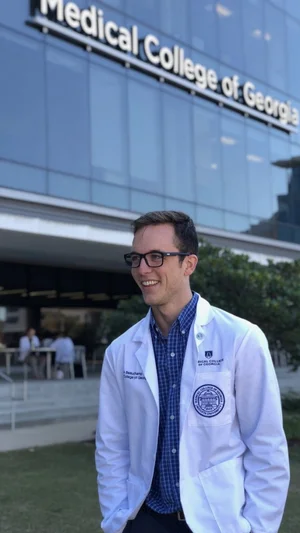
How “Ted Lasso” Can Make You a Better Doctor
published on MedCentral
Across the country, thousands of newly minted physicians are walking into hospitals carrying the same things: a stethoscope, years of preparation, and an astonishing amount of self-doubt.
Luckily, a mentor is waiting to help them navigate those uncertain waters: Ted Lasso.
On its surface, Ted Lasso is a comedy about an American football coach leading an English soccer club. Beneath its humor, however, is a story of optimism, humility, and choosing growth over ego. For physicians just beginning residency, three of Ted’s simplest lessons may also be among the most important:
Be Curious.
Be a Goldfish.
Believe.
“Be Curious”

Image courtesy of Apple TV Press
In the show’s first season,Ted Lasso finds himself challenged to a game of darts by the notorious Rupert Mannion, the club’s former owner, who arrogantly mistakes Ted’s kindness for incompetence. As they begin, Ted reflects that the people who underestimated him throughout his life never bothered to “be curious,” and rather made assumptions. Had Rupert been curious to get to know Ted before challenging him, he might have discovered that Ted had spent years playing darts with his father – and never would have underestimated him.
Every physician takes years to build their clinical judgment. What looks like instinct is really accumulated curiosity. Years spent asking why one patient looked sicker than another, why one treatment worked while another failed. Why one patient followed the textbook while another rewrote it entirely.
Every question you ask sharpens your clinical instincts. Every moment of uncertainty helps build judgment that one day will allow you to walk into a room and calmly know what needs to be done.
The physician you become is shaped not by how often you already know the answer, but by how relentlessly you pursue the ones you don’t.
All the nuts and bolts of becoming a doctor – understanding the hospital system, mastering your craft – come with repetition. Residency provides no shortage of that. But one of the few things that is hard to teach is how to be curious.
It’s okay not to know things.
In fact, that’s the point.
But ask. Question everything.
If a protocol doesn’t make sense, ask why. If you’re asked to perform an unfamiliar task, ask someone to teach you. If your attending chooses a different treatment plan than the one you expected, don’t simply memorize the answer – ask what they saw that you didn’t.
Seek out the experience of nurses, pharmacists, respiratory therapists, social workers, and every member of the health care team. Every person around you has spent years collecting lessons that cannot be found in a textbook. Grow from their wealth of knowledge.
Every shift, every day, is about getting a little bit better than you were the shift before. When you throw yourself into the uncomfortable, you find your knowledge gaps, and then you can fill them.
Ultimately, those who will benefit the most will be your patients.
Ted’s lesson isn’t simply a skill to expand your craft. It’s about becoming the kind of person who believes everyone has a story worth hearing. The more curious we become, the kinder we become. We find common ground where we expected conflict, understanding where we expected disagreement.
Curiosity asks us to let go of the illusion that we should already know everything. It doesn’t merely make us better physicians. It makes us better humans.
“Be a Goldfish”

Image courtesy of Apple TV Press
The second lesson comes afterTed witnesses one of his players, Sam, beat himself up for failing to make a tackle. He pulls Sam aside and asks, “Do you know who’s the happiest animal on the planet? A goldfish.Do you know why? Because they have a ten-second memory. Be a goldfish."
Remember this: you are going to make mistakes.
You’ll stumble through a presentation. You’ll blank on a fact you could recite effortlessly a year ago. You’ll struggle with a procedure you’ve performed before. You’ll find yourself wondering how everyone else seems to understand a hospital system that feels like a foreign language to you.
Residency is not designed to expose your inadequacy. It is designed to reveal and fill your knowledge gaps. Every physician that came before you has walked this same path. Every attending who now seems effortlessly confident once wondered, “How did I ever graduate medical school?”
You’re going to fail, but you can’t live in those failures. The goldfish lesson isn’t to say you should sweep those mistakes under the rug. You can only learn from what you remember.
You learn from them, grow from them, and move on to be ready to make the next mistake.
And the next one.
Extract the medicine. Leave behind the shame. Carry the lesson onward.
How do you do this in the moment, when embarrassment or self-doubt hits? Take time to reflect. Journal, keep your outside passions alive, remember your “why.”
And above all, find your support system.
Medicine has historically too often mistaken vulnerability for weakness. Vulnerability is where resilience begins. The doctor willing to expose their self-doubt gives everyone else permission to do the same. That’s how healthy cultures are built.
There is a gift in being vulnerable. Be vulnerable with your co-residents, friends, and family. Allow yourself five, ten minutes to feel the weight of the world with someone who understands.
And then, together be goldfish and swim on.
“Believe”
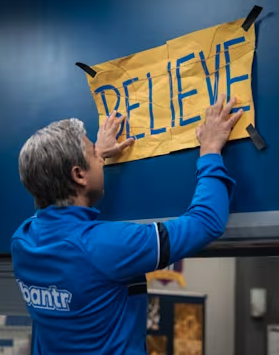
Image courtesy of Apple TV Press
There’s a third lesson that runs through the heart of Ted Lasso: believe. Fans of the show know all too well how Ted scatters“Believe” signs everywhere he can. They are constant reminders to believe in hope, in yourself, in good.
For new residents, remember to believe in all that brought you here. Believe in the years spent studying long after everyone else went to sleep. Believe in the patients who trusted you as a medical student. Believe in the countless moments of compassion, resilience, and perseverance that carried you from your first MCAT practice question to your first day as a licensed physician.
Most of all, believe in the physician you one day will become.
If you were ready to be a doctor right out of med school, we wouldn’t need residency.
Take a deep breath and remind yourself that you are here for a reason. You are capable.
So, as you walk the halls in your first days and weeks to come, let Ted Lasso be your unexpected medicine. Remember you are exactly where every physician before you once stood – uncertain, overwhelmed, yet slowly becoming the doctors your patients will one day remember.
Ted Lasso has always taught us that optimism is not naïveté. It is courage.
Residency asks for that same courage every single day.
Be curious.
Be a goldfish.
And above all, believe.
Tyler Beauchamp, MD, is a pediatric resident physician from UNC Children’s Hospital and a best-selling children’s/young adult author.